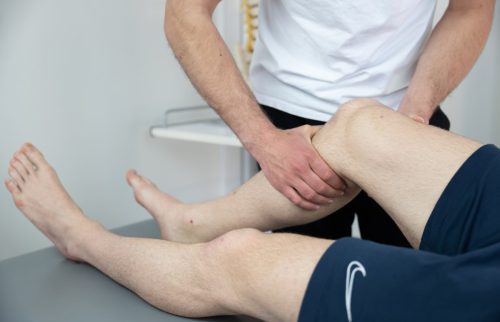

Recently, a football player sought assistance a few days after receiving a blow to the thigh during a match. Two days after the injury, the front muscle of the thigh was painful and slightly swollen, after a rough massage at the club, colloquially referred to as “dissolving the hematoma,” the swelling of the thigh increased even more.
Dissolving a hematoma
Description
Recently, a football player sought assistance a few days after receiving a blow to the thigh during a match. Two days after the injury, the front muscle of the thigh was painful and slightly swollen, after a rough massage at the club, colloquially referred to as “dissolving the hematoma,” the swelling of the thigh increased even more the following day, followed by a hematoma puncture. Upon examination in our clinic, a larger muscle rupture was visible on ultrasound, accompanied by swelling. Typically, such injuries require several weeks of rest from sports activities, along with appropriate physiotherapy.
But what about the technique of “dissolving“ the hematoma? This idea is very old and has been in sports physiotherapy since sports physiotherapy itself existed. The logic behind such therapy is that the local hematoma (blood located in the tissue, as a result of injury to blood vessels during muscle rupture or contusion) should be encouraged to spread to a larger area to facilitate easier absorption. This effort is based on physiology, and when done properly, it has the potential to significantly shorten the overall duration of treatment and accelerate the return to sport. The problem lies in timing and the dosage or intensity of such “massage.”
To be sure that the injured blood vessel has healed, time is needed, at least 48, preferably 72 hours after the injury. If the blood vessel has not healed, any massage, especially a rough one, can cause re-bleeding, increased hematoma, and worsening of the injury, which likely occurred in this specific case.
Extremely rough massage causes additional trauma to all tissues under pressure, along with reactive swelling, even when it’s not visible to the naked eye. Thus, traumatized surrounding tissues reduce hematoma absorption, simply because they are injured themselves and “occupied” with their own healing process.
Stimulation of the delocalization of post-traumatic hematoma (its spread to a larger area) through massage and other manual techniques is done with gentle to moderate pressure over a longer period. Such therapy does not have a destructive component and directly reduces recovery time.
RELATED CONTENTS
Premium
Plaćeno
Literally the entire medical profession and all patients, together with us, view knee osteoarthritis as damage to or wear of the cartilage in the joint. Although this observation is correct, the question remains what we can do regarding such damage, and the answer is very simple—absolutely nothing.

Premium
Plaćeno
A small bone embedded in the tendon of the large thigh muscle, which we call the patella or kneecap, is colloquially and incorrectly referred to as the “cap.” It is located on the front side of the knee and is very easy to locate when you run your hand over that spot. Its primary role is to serve as a fulcrum for the large thigh muscle during knee extension, just as a seesaw’s pivot point is in its middle.

Premium
Plaćeno
The main characteristic of this condition is pain in the knee area, specifically just below or above the patella (kneecap). This is the small bone located at the front of the knee, easily noticeable as it lies directly beneath the skin. Its function becomes clearer when understanding its position within the knee joint.

Premium
Plaćeno
Anterior knee pain is common in adolescents and young women, often with no clear diagnosis. Discover possible causes and treatment approaches using the holistic tension model.